Evidence and Research
Neurofeedback vs. Stimulants for ADHD: The Real Evidence
When parents research ADHD treatment, one question comes up every time: neurofeedback or medication, which one works? Both have real research behind them, but the standard comparison skips the most important variable: the individual brain producing those symptoms. ADHD is not one neurological pattern, and two children with identical diagnoses can have completely different brainwave profiles driving their attention difficulties. This article walks through the evidence honestly: what the trials found, where each treatment wins, and how brain data changes the conversation before any prescription gets written.
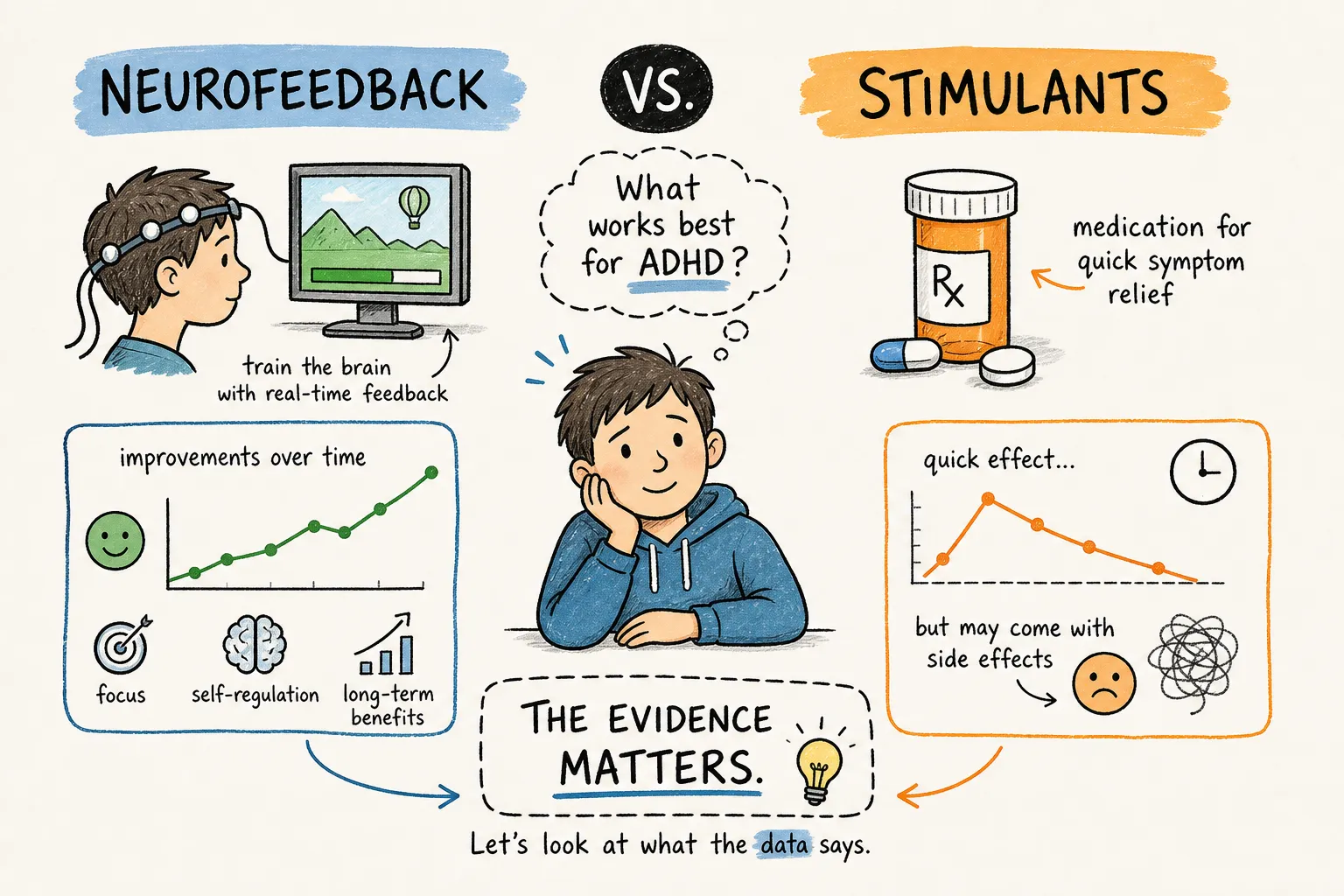
How each treatment actually works in the brain
The mechanics of neurofeedback: teaching the brain to self-regulate
Neurofeedback is not passive therapy. EEG sensors placed on the scalp measure real-time brainwave activity across specific frequency bands, and software feeds that information back to the person through visual or auditory cues. The brain receives moment-to-moment signals about its own activity and gradually learns to shift toward more regulated states.
The most commonly used protocol for ADHD is theta/beta ratio (TBR) training, which rewards the brain for reducing slow-wave theta activity and increasing faster beta activity, particularly over frontal and frontocentral regions. Sensorimotor rhythm (SMR) and slow cortical potential (SCP) protocols are also used depending on the presentation. Across trials that reported outcomes comparable to stimulant medication, protocols typically ran 30 to 40 sessions delivered two to three times per week over roughly 10 to 12 weeks.
What stimulant medications do pharmacologically
Methylphenidate and amphetamines work by increasing the availability of dopamine and norepinephrine in the prefrontal cortex, the brain region most directly involved in attention regulation and impulse control. The effect is pharmacologically immediate: most children show noticeable symptom changes within hours of the first dose. That speed is a genuine clinical advantage in acute situations. The mechanism is also straightforward to adjust through dose titration, which is why stimulants can be optimized relatively quickly compared to a neurofeedback training course.
Why the mechanism matters for treatment planning
Understanding how each treatment works reframes the entire comparison. Stimulants produce faster relief by flooding attentional circuits with the neurochemicals they need. Neurofeedback produces slower change by training the brain toward more regulated activity, a process thought to involve neuroplasticity, though direct evidence of lasting neuroplastic changes from clinical neurofeedback trials is still being established. One approach borrows function; the other works to build it. That distinction directly shapes expectations around side effects, timelines, and what happens when treatment stops.
Neurofeedback vs. stimulant medication for ADHD: what the clinical research shows
Head-to-head trial results: where each treatment leads
The direct-comparison RCT literature is genuinely mixed, and summarizing it honestly requires holding that ambiguity rather than resolving it prematurely. The Marx et al. multicentre trial found that optimally titrated methylphenidate outperformed theta/beta neurofeedback on attention, inhibition, and impulse control measures; notably, only methylphenidate showed neurophysiological changes that generalized to active task conditions. The Gevensleben trial found similar symptom reductions on parent and teacher ratings between the two treatments, with neurofeedback producing an edge in academic performance at follow-up. The BMC Psychiatry RCT found no significant group differences on parental symptom ratings, concluding that neurofeedback performed comparably to methylphenidate on those measures. Across the direct-comparison RCTs reviewed in the literature, roughly half found comparable symptom outcomes on parent and teacher ratings, a finding worth noting before any treatment decision is made.
What meta-analyses say about neurofeedback vs. stimulants for ADHD effectiveness
Stimulants remain stronger for immediate symptom control across the body of literature, particularly on blinded neuropsychological assessments. Neurofeedback effects are more consistent on parent and teacher ratings than on objective neuropsychological testing, and the evidence from better-controlled trials does not uniformly support neurofeedback as superior to stimulants on neurocognitive measures. What the meta-analytic literature also shows, however, is that neurofeedback is a clinically legitimate option: systematic reviews and meta-analyses characterize it as having modest but real evidence behind it, not as fringe or pseudoscientific practice.
Where neurofeedback holds its own: academic and behavioral outcomes
The Gevensleben finding on academic performance is worth highlighting specifically, because symptom scales and academic function are not the same thing. A child whose teacher rates them as less hyperactive still needs to perform in the classroom, and that functional outcome showed an edge for neurofeedback at follow-up. At the six-month mark, comparable parent-rated outcomes have been reported across multiple studies. This pattern becomes more meaningful when you factor in what happens after treatment ends.
Side effects, tolerability, and who stays in treatment
The real side effect profile of stimulant medications
The adverse effect profile of methylphenidate and amphetamines in pediatric trials is consistent across studies. Decreased appetite, sleep disruption, irritability, and abdominal pain are among the most frequently reported effects. Emotional lability and rebound effects when doses wear off are also well-documented. Longer-term reviews raise discussions about cardiovascular monitoring and potential growth effects. None of these are reasons to avoid medication categorically; for many children, the benefit clearly outweighs the burden. But for families already managing a child with emotional regulation challenges, adding irritability or sleep disruption to the picture is a real clinical consideration, not a trivial one.
Neurofeedback's safety profile in clinical trials
Across trials and systematic reviews, neurofeedback produced no major adverse events. Mild and temporary effects, occasional fatigue or brief headache, were noted in some participants but resolved without intervention. A 2022 meta-analysis pooling five RCTs with 305 participants found no elevated discontinuation risk associated with neurofeedback, reinforcing the tolerability picture the individual trial data already suggested. For a child who already struggles with mood dysregulation, the difference in side effect burden between these options carries clinical weight that symptom scales alone don't capture.
Dropout rates: what the evidence says about treatment adherence
In the meta-analysis of head-to-head trials, all-cause dropout was significantly lower with neurofeedback than with methylphenidate, with an odds ratio of 0.412 (95% CI: 0.186, 0.913). That finding rarely makes it into the clinical conversation, but it should. A treatment only works if the child stays in it. The tolerability gap between the two options shows up directly in completion rates, and for families weighing whether their child will sustain engagement with a longer protocol, that data point matters.
Long-term outcomes: what happens after treatment ends
Stimulant effects without the prescription
When stimulant medication stops, its benefits stop. There is no evidence that methylphenidate or amphetamines produce lasting neurological changes that carry forward after discontinuation. This is not a criticism of medication; it reflects how the pharmacology works. Families planning long-term care need to account for the fact that sustained benefit from stimulants requires sustained use, with all the dose management and monitoring that entails.
Neurofeedback's durability at 6 and 12 months
The follow-up data tell a different story for neurofeedback. Meta-analytic summaries consistently show that neurofeedback-produced symptom reductions were maintained at six to twelve months without additional sessions, with effects at that timepoint comparable to active treatments including methylphenidate. One multicenter trial of slow cortical potential neurofeedback reported improvements that were large and stable at six months. A separate review found that while methylphenidate produced stronger immediate effects, its advantage over neurofeedback narrowed considerably, and in some analyses became non-significant, by follow-up. The most consistent caveat is that this durability finding is stronger on parent and teacher ratings than on blinded objective assessments, and evidence quality varies by study design. The pattern is real enough, however, to shape how long-term treatment plans are structured.
When combining neurofeedback and stimulants makes sense
What the additive effects research actually shows
A 2022 meta-analysis pooling five RCTs with 305 participants found that combining EEG neurofeedback with stimulant medication produced small but statistically significant additive improvements in global ADHD symptoms and inattention based on parent ratings. No additional benefit emerged for hyperactivity/impulsivity, objective attention testing, or treatment discontinuation rates. Combination therapy is not a clear win across all outcomes, but for the inattention dimension specifically, the data suggest a modest benefit beyond what medication alone provides.
Reducing medication dose with neurofeedback support
Some theta/beta neurofeedback trials reported that children maintained symptom control while reducing their stimulant dose during or after neurofeedback training. For families whose primary concern is long-term medication dependence or managing side effects at higher doses, this is clinically relevant information. It remains a preliminary finding rather than a consensus recommendation, and it requires careful monitoring with a prescribing clinician. It does represent an active and legitimate area of clinical investigation, one that changes how combination treatment conversations can unfold.
Why a brain map should come before any treatment decision
How qEEG reveals what symptom checklists miss
Standard ADHD assessments rely on behavioral ratings and self-report: what a child does, how often, and in what settings. That information is valuable, but it tells you nothing about the specific neural patterns driving those behaviors. A quantitative EEG (qEEG) measures electrical activity across multiple brain regions simultaneously, revealing patterns such as elevated theta/beta ratios over frontal areas or underactivated frontocentral networks. Major clinical guidelines note that qEEG findings should inform, not single-handedly determine, treatment selection, and that they are most useful when integrated with symptom ratings and clinical judgment. Two children with identical symptom scores can have very different qEEG profiles, and the neurofeedback protocol, medication trial, or combination approach that makes the most clinical sense may differ significantly between them.
How Gray Matter Clinic uses qEEG to guide ADHD treatment planning
At Gray Matter Clinic, every ADHD case begins with a 60 to 120 minute qEEG brain mapping session that produces a detailed neurometric baseline. From that data, the clinical team identifies specific brain activity patterns associated with each child's attention, impulsivity, or processing challenges, whether elevated frontal theta, disrupted alpha regulation, or underconnected executive networks. The treatment plan is built around what the brain actually shows alongside the full clinical picture, not around a checklist alone. Families receive a structured, data-informed path forward that may include neurofeedback, collaboration with a prescribing physician around medication, or a combination approach guided by the neurometric findings. Progress is tracked across the entire program so families can see measurable change over time, not just hear about it.
Making the decision with your clinician, not instead of one
The neurofeedback versus medication question does not have to be an either/or choice made in the dark. With objective brain data in hand, the conversation with any treating clinician becomes more precise and more productive. Parents arrive at appointments with actual neurological context rather than just a symptom history, and that changes the quality of every treatment decision that follows, regardless of which path ultimately makes sense for a specific child.
Putting the evidence together
Here is where the research actually lands on neurofeedback vs. stimulant medication for ADHD: stimulants act faster and more consistently on neurocognitive measures in the short term. Neurofeedback shows comparable symptom outcomes in many trials and more durable gains after training ends. Combination therapy offers modest additive benefit for inattention specifically. The research does not crown a single winner, because the most important variable in this decision is not a population average from a meta-analysis. It is the individual brain in front of you.
That is precisely why starting with objective brain data changes the conversation. Before committing to a treatment direction, understanding the specific neural patterns underlying your child's ADHD gives every clinician involved, whether a neurofeedback therapist, a prescriber, or a psychotherapist, a concrete, data-informed foundation to work from rather than inference and trial and error alone.
If you're navigating the neurofeedback vs. stimulant medication question for your child and want to understand what their brain is actually doing, reach out to Gray Matter Clinic to learn more about qEEG brain mapping and how it guides personalized ADHD treatment planning. A brain map is one important data point, integrated with clinical assessment and specialist input, that can meaningfully sharpen the treatment decisions that follow.
How each treatment actually works in the brain
The mechanics of neurofeedback: teaching the brain to self-regulate
Neurofeedback is not passive therapy. EEG sensors placed on the scalp measure real-time brainwave activity across specific frequency bands, and software feeds that information back to the person through visual or auditory cues. The brain receives moment-to-moment signals about its own activity and gradually learns to shift toward more regulated states.
The most commonly used protocol for ADHD is theta/beta ratio (TBR) training, which rewards the brain for reducing slow-wave theta activity and increasing faster beta activity, particularly over frontal and frontocentral regions. Sensorimotor rhythm (SMR) and slow cortical potential (SCP) protocols are also used depending on the presentation. Across trials that reported outcomes comparable to stimulant medication, protocols typically ran 30 to 40 sessions delivered two to three times per week over roughly 10 to 12 weeks.
What stimulant medications do pharmacologically
Methylphenidate and amphetamines work by increasing the availability of dopamine and norepinephrine in the prefrontal cortex, the brain region most directly involved in attention regulation and impulse control. The effect is pharmacologically immediate: most children show noticeable symptom changes within hours of the first dose. That speed is a genuine clinical advantage in acute situations. The mechanism is also straightforward to adjust through dose titration, which is why stimulants can be optimized relatively quickly compared to a neurofeedback training course.
Why the mechanism matters for treatment planning
Understanding how each treatment works reframes the entire comparison. Stimulants produce faster relief by flooding attentional circuits with the neurochemicals they need. Neurofeedback produces slower change by training the brain toward more regulated activity, a process thought to involve neuroplasticity, though direct evidence of lasting neuroplastic changes from clinical neurofeedback trials is still being established. One approach borrows function; the other works to build it. That distinction directly shapes expectations around side effects, timelines, and what happens when treatment stops.
Neurofeedback vs. stimulant medication for ADHD: what the clinical research shows
Head-to-head trial results: where each treatment leads
The direct-comparison RCT literature is genuinely mixed, and summarizing it honestly requires holding that ambiguity rather than resolving it prematurely. The Marx et al. multicentre trial found that optimally titrated methylphenidate outperformed theta/beta neurofeedback on attention, inhibition, and impulse control measures; notably, only methylphenidate showed neurophysiological changes that generalized to active task conditions. The Gevensleben trial found similar symptom reductions on parent and teacher ratings between the two treatments, with neurofeedback producing an edge in academic performance at follow-up. The BMC Psychiatry RCT found no significant group differences on parental symptom ratings, concluding that neurofeedback performed comparably to methylphenidate on those measures. Across the direct-comparison RCTs reviewed in the literature, roughly half found comparable symptom outcomes on parent and teacher ratings, a finding worth noting before any treatment decision is made.
What meta-analyses say about neurofeedback vs. stimulants for ADHD effectiveness
Stimulants remain stronger for immediate symptom control across the body of literature, particularly on blinded neuropsychological assessments. Neurofeedback effects are more consistent on parent and teacher ratings than on objective neuropsychological testing, and the evidence from better-controlled trials does not uniformly support neurofeedback as superior to stimulants on neurocognitive measures. What the meta-analytic literature also shows, however, is that neurofeedback is a clinically legitimate option: systematic reviews and meta-analyses characterize it as having modest but real evidence behind it, not as fringe or pseudoscientific practice.
Where neurofeedback holds its own: academic and behavioral outcomes
The Gevensleben finding on academic performance is worth highlighting specifically, because symptom scales and academic function are not the same thing. A child whose teacher rates them as less hyperactive still needs to perform in the classroom, and that functional outcome showed an edge for neurofeedback at follow-up. At the six-month mark, comparable parent-rated outcomes have been reported across multiple studies. This pattern becomes more meaningful when you factor in what happens after treatment ends.
Side effects, tolerability, and who stays in treatment
The real side effect profile of stimulant medications
The adverse effect profile of methylphenidate and amphetamines in pediatric trials is consistent across studies. Decreased appetite, sleep disruption, irritability, and abdominal pain are among the most frequently reported effects. Emotional lability and rebound effects when doses wear off are also well-documented. Longer-term reviews raise discussions about cardiovascular monitoring and potential growth effects. None of these are reasons to avoid medication categorically; for many children, the benefit clearly outweighs the burden. But for families already managing a child with emotional regulation challenges, adding irritability or sleep disruption to the picture is a real clinical consideration, not a trivial one.
Neurofeedback's safety profile in clinical trials
Across trials and systematic reviews, neurofeedback produced no major adverse events. Mild and temporary effects, occasional fatigue or brief headache, were noted in some participants but resolved without intervention. A 2022 meta-analysis pooling five RCTs with 305 participants found no elevated discontinuation risk associated with neurofeedback, reinforcing the tolerability picture the individual trial data already suggested. For a child who already struggles with mood dysregulation, the difference in side effect burden between these options carries clinical weight that symptom scales alone don't capture.
Dropout rates: what the evidence says about treatment adherence
In the meta-analysis of head-to-head trials, all-cause dropout was significantly lower with neurofeedback than with methylphenidate, with an odds ratio of 0.412 (95% CI: 0.186, 0.913). That finding rarely makes it into the clinical conversation, but it should. A treatment only works if the child stays in it. The tolerability gap between the two options shows up directly in completion rates, and for families weighing whether their child will sustain engagement with a longer protocol, that data point matters.
Long-term outcomes: what happens after treatment ends
Stimulant effects without the prescription
When stimulant medication stops, its benefits stop. There is no evidence that methylphenidate or amphetamines produce lasting neurological changes that carry forward after discontinuation. This is not a criticism of medication; it reflects how the pharmacology works. Families planning long-term care need to account for the fact that sustained benefit from stimulants requires sustained use, with all the dose management and monitoring that entails.
Neurofeedback's durability at 6 and 12 months
The follow-up data tell a different story for neurofeedback. Meta-analytic summaries consistently show that neurofeedback-produced symptom reductions were maintained at six to twelve months without additional sessions, with effects at that timepoint comparable to active treatments including methylphenidate. One multicenter trial of slow cortical potential neurofeedback reported improvements that were large and stable at six months. A separate review found that while methylphenidate produced stronger immediate effects, its advantage over neurofeedback narrowed considerably, and in some analyses became non-significant, by follow-up. The most consistent caveat is that this durability finding is stronger on parent and teacher ratings than on blinded objective assessments, and evidence quality varies by study design. The pattern is real enough, however, to shape how long-term treatment plans are structured.
When combining neurofeedback and stimulants makes sense
What the additive effects research actually shows
A 2022 meta-analysis pooling five RCTs with 305 participants found that combining EEG neurofeedback with stimulant medication produced small but statistically significant additive improvements in global ADHD symptoms and inattention based on parent ratings. No additional benefit emerged for hyperactivity/impulsivity, objective attention testing, or treatment discontinuation rates. Combination therapy is not a clear win across all outcomes, but for the inattention dimension specifically, the data suggest a modest benefit beyond what medication alone provides.
Reducing medication dose with neurofeedback support
Some theta/beta neurofeedback trials reported that children maintained symptom control while reducing their stimulant dose during or after neurofeedback training. For families whose primary concern is long-term medication dependence or managing side effects at higher doses, this is clinically relevant information. It remains a preliminary finding rather than a consensus recommendation, and it requires careful monitoring with a prescribing clinician. It does represent an active and legitimate area of clinical investigation, one that changes how combination treatment conversations can unfold.
Why a brain map should come before any treatment decision
How qEEG reveals what symptom checklists miss
Standard ADHD assessments rely on behavioral ratings and self-report: what a child does, how often, and in what settings. That information is valuable, but it tells you nothing about the specific neural patterns driving those behaviors. A quantitative EEG (qEEG) measures electrical activity across multiple brain regions simultaneously, revealing patterns such as elevated theta/beta ratios over frontal areas or underactivated frontocentral networks. Major clinical guidelines note that qEEG findings should inform, not single-handedly determine, treatment selection, and that they are most useful when integrated with symptom ratings and clinical judgment. Two children with identical symptom scores can have very different qEEG profiles, and the neurofeedback protocol, medication trial, or combination approach that makes the most clinical sense may differ significantly between them.
How Gray Matter Clinic uses qEEG to guide ADHD treatment planning
At Gray Matter Clinic, every ADHD case begins with a 60 to 120 minute qEEG brain mapping session that produces a detailed neurometric baseline. From that data, the clinical team identifies specific brain activity patterns associated with each child's attention, impulsivity, or processing challenges, whether elevated frontal theta, disrupted alpha regulation, or underconnected executive networks. The treatment plan is built around what the brain actually shows alongside the full clinical picture, not around a checklist alone. Families receive a structured, data-informed path forward that may include neurofeedback, collaboration with a prescribing physician around medication, or a combination approach guided by the neurometric findings. Progress is tracked across the entire program so families can see measurable change over time, not just hear about it.
Making the decision with your clinician, not instead of one
The neurofeedback versus medication question does not have to be an either/or choice made in the dark. With objective brain data in hand, the conversation with any treating clinician becomes more precise and more productive. Parents arrive at appointments with actual neurological context rather than just a symptom history, and that changes the quality of every treatment decision that follows, regardless of which path ultimately makes sense for a specific child.
Putting the evidence together
Here is where the research actually lands on neurofeedback vs. stimulant medication for ADHD: stimulants act faster and more consistently on neurocognitive measures in the short term. Neurofeedback shows comparable symptom outcomes in many trials and more durable gains after training ends. Combination therapy offers modest additive benefit for inattention specifically. The research does not crown a single winner, because the most important variable in this decision is not a population average from a meta-analysis. It is the individual brain in front of you.
That is precisely why starting with objective brain data changes the conversation. Before committing to a treatment direction, understanding the specific neural patterns underlying your child's ADHD gives every clinician involved, whether a neurofeedback therapist, a prescriber, or a psychotherapist, a concrete, data-informed foundation to work from rather than inference and trial and error alone.
If you're navigating the neurofeedback vs. stimulant medication question for your child and want to understand what their brain is actually doing, reach out to Gray Matter Clinic to learn more about qEEG brain mapping and how it guides personalized ADHD treatment planning. A brain map is one important data point, integrated with clinical assessment and specialist input, that can meaningfully sharpen the treatment decisions that follow.
Blog & news